How to Choose the Right Carbon Fiber Webbing?
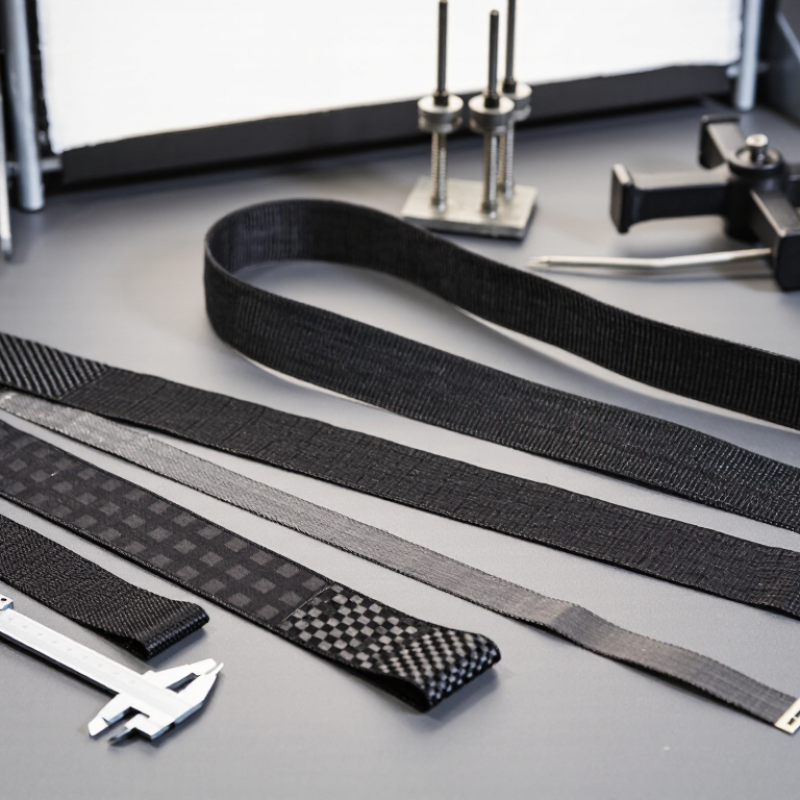
Choosing Carbon Fiber Webbing starts with the job it must perform, not the most impressive specification on a product page. A strap for a lightweight fixture may need different flexibility and edge stability than a narrow reinforcement tape. Width, weave, thickness, fiber grade, and resin compatibility all affect the result. Small details matter.
Toray’s T700S carbon-fiber technical data sheet lists typical tensile strength of 4,900 MPa, tensile modulus of 230 GPa, and density of 1.80 g/cm³. These figures describe the fiber, not a finished webbing product. Weave pattern, coating, stitching, and handling can change how a finished strap performs. Treat raw-fiber data as a starting point, not a guarantee.
Market reports add context, but not a buying answer. Grand View Research estimated the global carbon-fiber market at USD 5.48 billion in 2023 and forecast growth through 2030. That estimate signals wider industrial interest; it does not prove that every webbing type suits a particular application. A supplier’s test results for the actual construction are more useful.
Ask for documented breaking strength, elongation, temperature limits, and lot consistency. Check whether the quoted load is straight-pull strength or applies to a stitched assembly. Then inspect a sample: bend it around the intended radius, examine the edges, and confirm that it stays stable under handling. There is no universal best choice. Even careful selection can miss a real-use issue, so validate the finished design under representative conditions.
Define the Required Load, Working Load Limit, and Safety Factor
How to Choose the Right Carbon Fiber Webbing?
Define the Required Load, Working Load Limit, and Safety Factor
Start with the heaviest load the webbing must support, including attached hardware and any load movement. A static 40-kilogram panel can create higher forces if it swings or is suddenly stopped. Record the load direction, contact points, and intended webbing configuration. Small details matter. Carbon fiber webbing may have limited stretch, so a sharp edge or abrupt impact can concentrate stress.
Working Load Limit (WLL) is the maximum service load specified for a particular product and setup. Do not treat a breaking-strength figure as its WLL. The safety factor is the ratio between breaking strength and WLL; it is not spare capacity for exceeding the stated limit. Confirm the manufacturer’s rating, test basis, and approved use. If those details are unclear, pause rather than estimate.
Tips: Check the complete assembly, including seams, stitching, and connectors. Keep the webbing flat and inspect for fraying, cuts, or crushed fibers before use.
Recheck the WLL when changing the wrap, angle, or hardware, because the load on each section can change. A rating for a straight pull may not apply to a loop or angled setup. I would not assume two equal-looking straps share a load evenly; small differences in length can leave one carrying more. Use documented ratings for the actual arrangement, and replace damaged webbing instead of relying on appearance alone.
Compare Fiber Grades: Typical Modulus Ranges from 230 to 600 GPa
How to Choose the Right Carbon Fiber Webbing?
Fiber grades are often compared by tensile modulus, measured in gigapascals (GPa). Industry technical data commonly places standard-modulus fibers around 230–250 GPa, intermediate grades near 290–300 GPa, high-modulus grades around 350–450 GPa, and ultra-high-modulus grades near 500–600 GPa. CMH-17 composite-material property tables provide a technical reference for comparing material data. ASTM D4018 describes tensile testing of carbon-fiber tows. These figures describe fibers or tows, not a finished webbing strap.
Weave matters. A tightly woven strip can still show lower effective stiffness because fibers bend over and under neighboring bundles. Resin content, width, thickness, and loading direction also affect performance. For a strap running over a small roller, flexibility and resistance to abrasion may matter more than the highest modulus figure. The bigger number can look convincing, but it may be the wrong choice.
Tip: Ask for test data on the actual webbing, including tensile strength, elongation, and test direction. Compare samples under the same load and setup. Check the edges, too; fraying can complicate handling. A fiber-grade label alone is not enough.
How to Choose the Right Carbon Fiber Webbing? — Compare Fiber Grades: Typical Modulus Ranges from 230 to 600 GPa
| Fiber Grade |
Typical Tensile Modulus |
Typical Tensile Strength |
Key Characteristics |
Common Selection Considerations for Webbing |
| Standard Modulus (SM) |
230–250 GPa |
3.5–5.0 GPa |
Balanced stiffness and tensile performance; generally offers comparatively good strain capacity within carbon fiber grades. |
A practical starting point when strength, flexibility, availability, and cost balance matter more than maximum stiffness. |
| Intermediate Modulus (IM) |
280–320 GPa |
4.5–6.0 GPa |
Higher stiffness than standard-modulus fiber while retaining high tensile strength in many product specifications. |
Consider for lightweight webbing that needs increased stiffness without moving to the most brittle, very-high-modulus options. |
| High Modulus (HM) |
350–450 GPa |
3.5–5.0 GPa |
High stiffness, often with lower tensile strain to failure than standard- or intermediate-modulus fiber. |
Useful when dimensional stability and stiffness are priorities; check bending, abrasion, and handling requirements for the finished weave. |
| Ultra-High Modulus (UHM) |
500–600 GPa |
2.5–4.0 GPa |
Very high axial stiffness; strength and strain-to-failure can be lower than in less stiff grades. |
Reserve for applications where maximum stiffness is essential and the webbing can be protected from sharp bends and demanding flex fatigue. |
| Important: These are indicative ranges for carbon fibers, not guaranteed values for finished webbing. Actual properties vary by fiber product, precursor, manufacturing process, test method, tow size, weave, and finishing. Compare certified datasheets and evaluate the finished webbing under the intended load, bend radius, abrasion, and environmental conditions. |
Match Weave and Webbing Width to Load Direction and Bend Radius
Choosing carbon fiber webbing starts with the force path, not the catalog photo. If tension runs lengthwise, align the primary load with the warp yarns; crosswise yarns mainly stabilize the weave. Plain weave feels stable and handles well, while twill bends more easily around gentle curves. Neither is automatically stronger. Check actual data.
Width changes how load spreads across a joint, but it does not guarantee a stronger assembly. A narrow strip can concentrate force near a stitch line or sharp corner. A wider strip may wrinkle on a curved surface. Choose width based on the attachment area, edge clearance, and expected load, then inspect the full joint. Small details count. Stitching, bonding, and edge finishing can limit performance before the fibers do.
Bend radius matters just as much. Pull a sample around the smallest real curve and look for flattened yarns, fraying, or lifted edges. Repeated tight bending can damage the weave and weaken load transfer. Do not assume a neat-looking strip is safe. Use test data and evaluate the finished assembly under representative loading. In practice, the first fit is not always the best fit.
How to Choose Carbon Fiber Webbing: Match Weave and Width to Load Direction and Bend Radius
The chart shows the geometric alignment factor, cos²(θ), for fibers at an angle to the load—not measured webbing strength. Align the principal yarn direction with the main load; for loads in multiple directions, consider a balanced weave. Choose webbing width to suit the load path and hardware, and follow the material supplier’s guidance for bend radius, since tight bends can damage fibers and reduce performance.
Check Areal Weight and Fiber Density of About 1.75–1.95 g/cm³
When comparing carbon fiber webbing, check areal weight in grams per square meter and fiber density separately. Areal weight tells you how much material covers a given area; it affects handling, thickness, and mass. Fiber density, commonly around 1.75–1.95 g/cm³, describes the carbon fiber itself, not the finished webbing. Resin, coatings, and weave structure can change the finished product’s weight.
Ask for the stated areal weight and how it was measured. A practical check is to cut a clean, measured sample, weigh it on a calibrated scale, and calculate its mass per square meter. Keep the sample flat. Frayed edges or uneven coatings can distort the result. Small samples are convenient, but they may not represent a full roll. That part is easy to overlook.
Use the density range as a reasonableness check, not a pass-or-fail rule. Confirm whether a supplier’s figure applies to the fiber or to a composite sample, and request the test method when the distinction is unclear. Then compare webbing with the same weave, width, and finish. A heavier strip may simply contain more fibers, but it could also include extra coating. I would not judge strength from weight alone; the spec sheet should also identify construction and tensile performance. A neat number can still hide an incomplete description.
Verify Breaking Strength and Elongation Using ASTM D6775 Data
How to Choose the Right Carbon Fiber Webbing?
When comparing carbon fiber webbing, look beyond a catalog strength figure. Ask for test results produced using ASTM D6775, which covers breaking strength and elongation testing for textile webbing, tape, and related materials. Check that the report identifies the webbing width, construction, specimen count, conditioning, and test method. Results are hard to compare when these details differ.
Breaking strength indicates the force at failure under the stated test conditions; it is not a safe working load. Elongation shows how much the specimen stretches before or at break, depending on how the report defines it. A stiff webbing may suit a dimensionally stable assembly, while a more extensible option may absorb movement. Review individual readings as well as averages. A neat average can conceal inconsistent specimens. Also, a lab coupon cannot fully predict seams, hardware, wear, or real-world loading.
Tips: Match test data to your application, then evaluate the complete assembly. Confirm whether elongation is reported as a percentage and at what load. If a report is missing details, request clarification. I would treat a single strong result cautiously; material variation is easy to overlook.